What the MHRA, EMA and FDA say about PSSD
Three medicines regulators have added persistent sexual dysfunction to SSRI labels. The FDA has not, and is being sued over it.
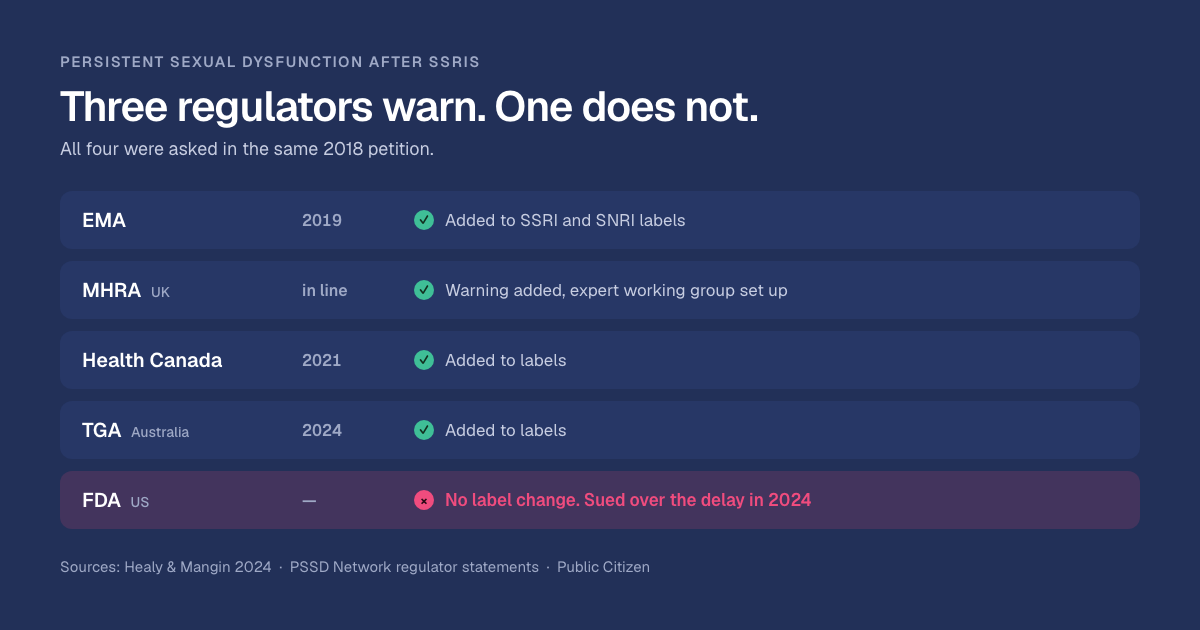
Four medicines regulators have been asked to warn that sexual side effects from SSRIs can continue after the tablets stop. Three of them have done it. The fourth has been sued.
Where each regulator stands
- EMA, Europe
- 2019. Added persistent sexual dysfunction to SSRI and SNRI labels
- MHRA, UK
- Added a warning in line with the EMA decision, and set up an expert working group
- Health Canada
- 2021. Added it to labels
- TGA, Australia
- 2024. Added it to labels
- FDA, United States
- No label change
The EMA and Health Canada decisions are documented by Healy and Mangin, 2024. The MHRA and TGA positions are set out on the PSSD Network’s record of regulator statements.
What started it
In 2018 RxISK filed a citizen petition with the EMA, Health Canada and the FDA. It asked them to warn that sexual dysfunction from SSRIs and SNRIs can persist after stopping, and to write to prescribers. Twenty-two people signed it, most of them authors of the published research on the condition.
The EMA acted the following year. Health Canada followed in 2021, Australia in 2024.
The FDA has not answered
The petition received two acknowledgement letters and nothing further. It remains lodged in the FDA’s citizen petition process.
In May 2024 one of the signatories, Dr Antonei Csoka, began legal action against the FDA over the delay, represented by Public Citizen. RxISK has published its own account of the case.
There is no black box warning for PSSD on any American antidepressant label, and no FDA statement recognising the condition.
What this means if you are reporting
The asymmetry changes what your report is doing, depending on where you are.
In the UK and Europe, the warning already exists and the MHRA has an expert working group examining the question. A report there adds to a body of evidence a regulator has already accepted the premise of.
In the United States, reports go into FAERS, the FDA’s adverse event database, through MedWatch. That is the record any future decision would be based on, and it is currently the main thing a person can add to.
Neither system stores your words. Both store a code.
MedDRA code 10086208
English term: Post-SSRI sexual dysfunction
Use it if you took an SSRI or SNRI. Write that exact wording in the free-text box, then describe your symptoms in your own words. “PSSD” is the patient name and is not in the dictionary, so do not use it alone. Our reporting guide covers the UK Yellow Card scheme, the US MedWatch form, and 63 other countries.
Healy and Mangin note that the code exists but “does not appear to have been adopted by regulators”. Writing the exact term into your report is what gives an assessor the chance to code it correctly.
Why the label matters
A label change is not a cure and it does not help anyone already affected. What it does is settle the argument about whether the thing exists.
If a prescriber tells you sexual side effects always resolve within a few weeks of stopping, the European, British, Canadian and Australian labels now say otherwise. That is a document, not an opinion, and you can take it to an appointment.
If you are struggling with your mental health, the Samaritans are on 116 123, free, at any hour.