Genital numbness after an SSRI
In PSSD, genital numbness is the symptom that tells the condition apart from depression returning. What the research shows, and how to report it.
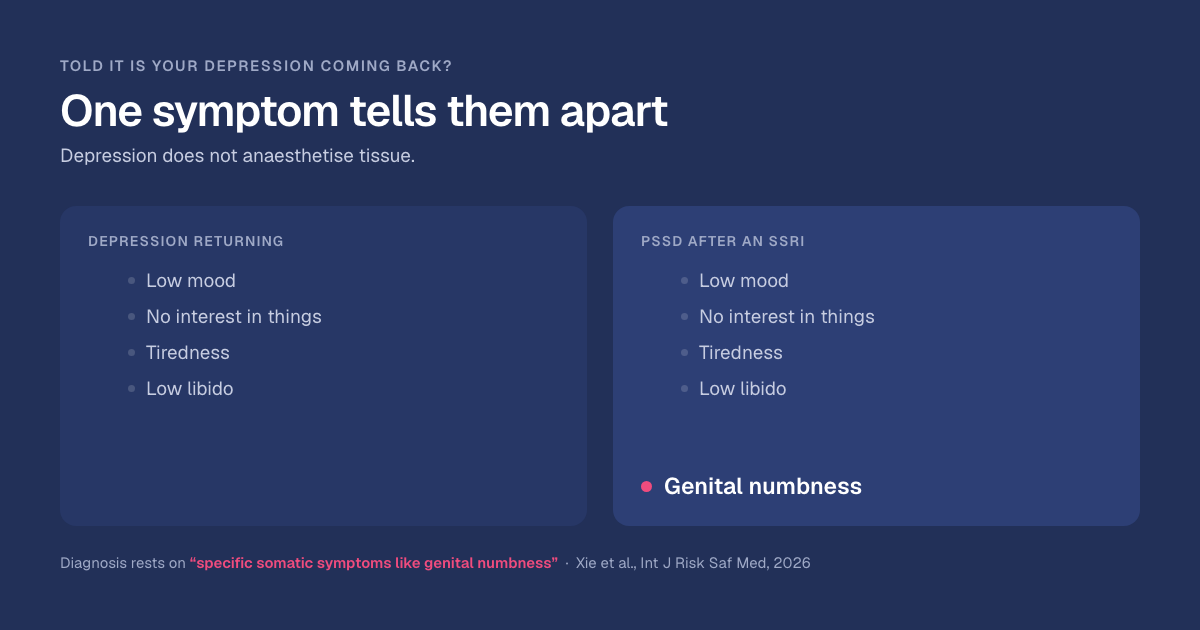
Reduced or absent genital sensation after an SSRI is a recognised symptom of PSSD. It has a name, a role in diagnosis, and a MedDRA code that regulators can file it under. It is not a sign that your depression is returning, and in the research it is the symptom used to tell those two apart.
What people describe
This is a change in physical sensation rather than in mood or interest. People describe touch that registers as pressure without feeling, skin that seems to belong to someone else, or a layer between them and everything they touch. Some lose sensation completely. More often the erotic quality of touch goes while ordinary touch still works.
The clinical name is persistent post-treatment genital hypoesthesia, and it appears in the 2022 diagnostic criteria for PSSD, post-SSRI sexual dysfunction. Those criteria also list reduced nipple sensitivity and sensory changes affecting skin, smell, taste or vision.
How it is told apart from depression
A 2026 systematic review in the International Journal of Risk & Safety in Medicine found that diagnosis rests on “specific somatic symptoms like genital numbness” to distinguish PSSD from depression returning.
That distinction is worth understanding, because low libido and flat mood look the same from the outside whichever is causing them. Numbness does not, since depression does not anaesthetise tissue.
What the research found
Pirani and colleagues surveyed 2,179 people with a history of psychiatric treatment. Their results appeared online in 2024 and in print in Social Psychiatry and Psychiatric Epidemiology, 2025.
- Past antidepressants
- 13.2% reported persistent genital numbness (93 of 707)
- Other psychiatric drugs
- 0.9% (1 of 102)
- Adjusted odds
- 14.2 times higher
That figure carries a significant limit. The participants were a subsample of UnACoRN, a survey of sexual and gender minority people aged 15 to 29 in the US and Canada, so 13.2% is not a rate for the general population. What the study establishes is the scale of the difference between two groups answering the same question.
The 2026 review reports that symptoms persisted beyond six months in up to 74% of affected cohorts. That describes how long symptoms lasted among people who already had them, not the likelihood of developing them.
What may cause it
No mechanism has been proven. The 2026 review sets out three candidates under investigation: desensitisation of 5-HT1A serotonin receptors, depletion of the neurosteroid allopregnanolone through 5-alpha-reductase inhibition, and epigenetic silencing of dopamine reward circuits.
The second of those connects two conditions. 5-alpha-reductase is the enzyme finasteride blocks, which is part of why PSSD and post-finasteride syndrome are studied together and share one set of diagnostic criteria.
Treatment
No approved treatment exists. The 2026 review describes off-label dopamine agonists and low-power laser therapy as showing preliminary promise. That means both have been tried in small numbers of people, and neither has evidence behind it yet.
Anyone selling you a cure for this is ahead of the evidence.
Reporting it
Regulators store a code rather than your words. A report filed under a general term cannot be found again by anyone counting cases.
MedDRA code 10086208
English term: Post-SSRI sexual dysfunction
Use it if you took an SSRI or SNRI. Write that exact wording in the free-text box, then describe the numbness in your own words. “PSSD” is the patient name and is not in the dictionary, so do not use it alone. Our reporting guide covers the UK, the US and 63 other countries.
You do not need a doctor to agree with you, you do not need proof, and you can report years after stopping.
Someone describing it
Grant, on what the numbness is actually like.

There are more interviews here.
If you are struggling with your mental health, the Samaritans are on 116 123, free, at any hour.