Emotional blunting on antidepressants
Around 46% of people on antidepressants report emotional blunting. The research shows it is separable from the depression itself.
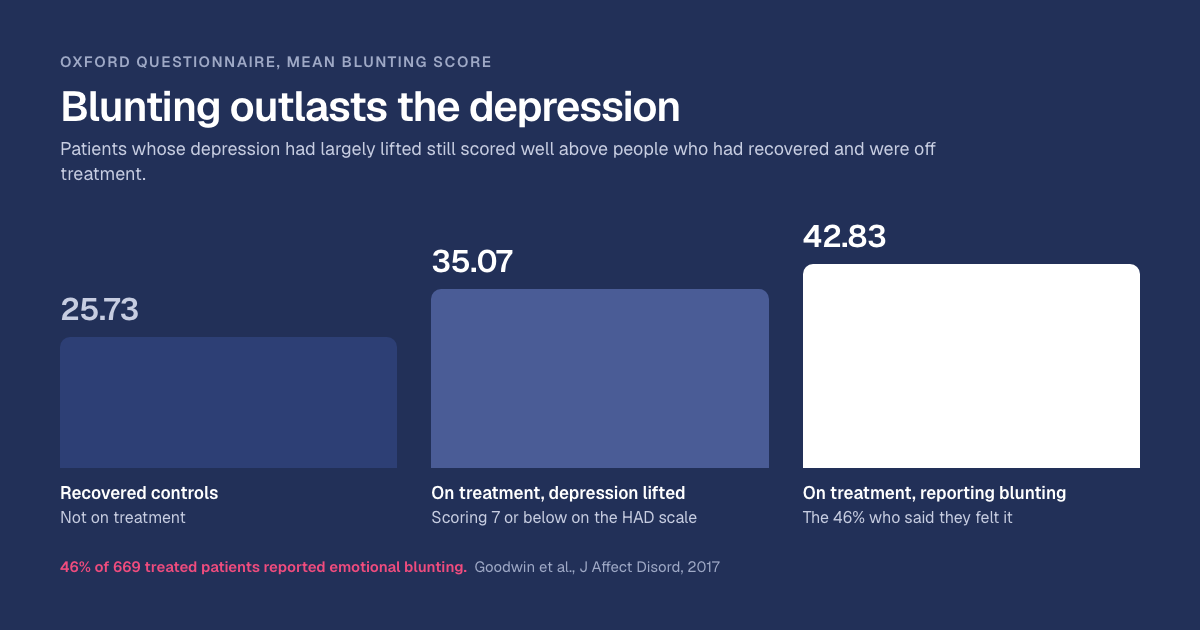
Feeling flattened rather than better is one of the most common experiences on an antidepressant, and one of the least discussed. In the largest survey of it, 46% of treated patients reported emotional blunting.
What people mean by it
Blunting is not sadness and it is not relief. People describe a narrowing of feeling in both directions: less despair, but also less pleasure, less love, and less interest in the people they are closest to. Some say they stopped crying at things that would once have moved them. Others describe watching their own life through glass.
It is often welcome at first, particularly to somebody who was in acute distress. It becomes a problem when it does not lift.
What the research found
Goodwin and colleagues surveyed 669 depressed patients on antidepressant treatment and 150 recovered controls, and published the results in the Journal of Affective Disorders in 2017.
- Reported blunting
- 46% of treated patients
- By sex
- 52% of men, 44% of women
- By drug
- No difference between agents, though less frequent with bupropion
It is separable from the depression
The most useful finding in that survey is easy to miss. Patients whose depression had largely lifted, scoring 7 or below on the Hospital Anxiety and Depression scale, still recorded a mean blunting score of 35.07. Recovered controls, who were not on treatment, scored 25.73.
In other words, the blunting persisted in people whose depression had substantially resolved. If a prescriber tells you that flatness is simply your depression, this survey found otherwise in the group where depression was least active.
One thing to know about the study: it was co-authored by researchers at Servier, a pharmaceutical company. That does not make the 46% wrong, and the survey remains the largest of its kind, but the emotional blunting literature is substantially industry-funded and worth reading with that in view.
When it does not stop
For most people, blunting eases after the drug is stopped. For some it does not.
Emotional numbing appears in the 2022 diagnostic criteria for PSSD, the syndrome in which sexual and emotional effects continue after an SSRI is stopped. Those criteria also list depersonalisation, which is the sense of detachment from yourself that some people describe alongside it.
That places persistent blunting inside a recognised condition rather than outside medicine, which matters when you are trying to be believed.
Someone describing it

Nick, describing living with both the sexual and the emotional effects. There are more interviews here.
What you can do
Do not stop an antidepressant because of anything on this page.
Stopping suddenly can cause severe withdrawal effects, and for some people the underlying condition returns. Blunting is a reasonable thing to raise with the person who prescribed it, and this survey is a reasonable thing to raise alongside it.
If the blunting has continued after you stopped, it can be reported.
MedDRA code 10086208
English term: Post-SSRI sexual dysfunction
This is the term regulators file the syndrome under, and emotional numbing is one of its listed symptoms. Write that exact wording in the free-text box, then describe what changed in your own words. Our reporting guide covers 65 countries.
If you are struggling with your mental health, the Samaritans are on 116 123, free, at any hour.